Ebook Free The Energy of Slaves: Oil and the New Servitude, by Andrew Nikiforuk
Are you thinking about mainly publications The Energy Of Slaves: Oil And The New Servitude, By Andrew Nikiforuk If you are still puzzled on which of guide The Energy Of Slaves: Oil And The New Servitude, By Andrew Nikiforuk that need to be bought, it is your time to not this site to seek. Today, you will require this The Energy Of Slaves: Oil And The New Servitude, By Andrew Nikiforuk as the most referred publication as well as the majority of needed publication as resources, in various other time, you could take pleasure in for a few other publications. It will certainly depend upon your willing requirements. However, we constantly recommend that publications The Energy Of Slaves: Oil And The New Servitude, By Andrew Nikiforuk can be a terrific problem for your life.
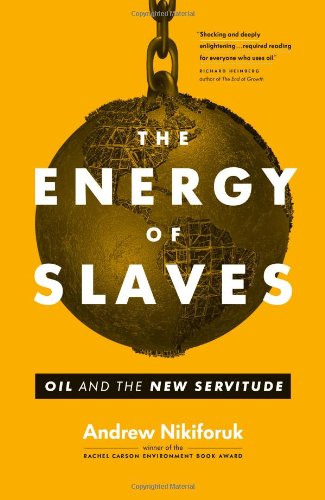
The Energy of Slaves: Oil and the New Servitude, by Andrew Nikiforuk

Ebook Free The Energy of Slaves: Oil and the New Servitude, by Andrew Nikiforuk
Why should await some days to get or obtain the book The Energy Of Slaves: Oil And The New Servitude, By Andrew Nikiforuk that you get? Why ought to you take it if you can get The Energy Of Slaves: Oil And The New Servitude, By Andrew Nikiforuk the faster one? You can find the exact same book that you order here. This is it guide The Energy Of Slaves: Oil And The New Servitude, By Andrew Nikiforuk that you could get straight after purchasing. This The Energy Of Slaves: Oil And The New Servitude, By Andrew Nikiforuk is popular book worldwide, of course many people will attempt to have it. Why do not you become the very first? Still puzzled with the way?
For everyone, if you intend to begin accompanying others to review a book, this The Energy Of Slaves: Oil And The New Servitude, By Andrew Nikiforuk is much recommended. And also you should obtain guide The Energy Of Slaves: Oil And The New Servitude, By Andrew Nikiforuk right here, in the link download that we give. Why should be below? If you desire various other kind of books, you will certainly consistently locate them and The Energy Of Slaves: Oil And The New Servitude, By Andrew Nikiforuk Economics, national politics, social, scientific researches, faiths, Fictions, and a lot more publications are provided. These available publications remain in the soft data.
Why should soft documents? As this The Energy Of Slaves: Oil And The New Servitude, By Andrew Nikiforuk, lots of people additionally will need to get the book faster. But, in some cases it's up until now means to get guide The Energy Of Slaves: Oil And The New Servitude, By Andrew Nikiforuk, even in other nation or city. So, to ease you in finding the books The Energy Of Slaves: Oil And The New Servitude, By Andrew Nikiforuk that will certainly sustain you, we help you by providing the lists. It's not just the list. We will offer the advised book The Energy Of Slaves: Oil And The New Servitude, By Andrew Nikiforuk web link that can be downloaded and install straight. So, it will certainly not require more times as well as days to posture it as well as other books.
Accumulate the book The Energy Of Slaves: Oil And The New Servitude, By Andrew Nikiforuk begin with currently. However the extra way is by collecting the soft documents of the book The Energy Of Slaves: Oil And The New Servitude, By Andrew Nikiforuk Taking the soft documents can be saved or stored in computer or in your laptop. So, it can be greater than a book The Energy Of Slaves: Oil And The New Servitude, By Andrew Nikiforuk that you have. The most convenient means to expose is that you can likewise conserve the soft file of The Energy Of Slaves: Oil And The New Servitude, By Andrew Nikiforuk in your suitable and available device. This condition will certainly mean you frequently read The Energy Of Slaves: Oil And The New Servitude, By Andrew Nikiforuk in the spare times greater than talking or gossiping. It will certainly not make you have bad habit, but it will lead you to have better practice to read book The Energy Of Slaves: Oil And The New Servitude, By Andrew Nikiforuk.
By the winner of the Rachel Carson Environment Book Award
Ancient civilizations relied on shackled human muscle. It took the energy of slaves to plant crops, clothe emperors, and build cities. Nineteenth-century slaveholders viewed critics as hostilely as oil companies and governments now regard environmentalists. Yet the abolition movement had an invisible ally: coal and oil. As the world's most versatile workers, fossil fuels replenished slavery's ranks with combustion engines and other labor-saving tools. Since then, cheap oil has transformed politics, economics, science, agriculture, and even our concept of happiness. Many North Americans today live as extravagantly as Caribbean plantation owners. We feel entitled to surplus energy and rationalize inequality, even barbarity, to get it. But endless growth is an illusion.
What we need, Andrew Nikiforuk argues in this provocative new book, is a radical emancipation movement that ends our master-and-slave approach to energy. We must learn to use energy on a moral, just, and truly human scale.
- Sales Rank: #884244 in Books
- Brand: Brand: Greystone Books
- Published on: 2012-09-18
- Original language: English
- Number of items: 1
- Dimensions: 8.60" h x 1.10" w x 5.60" l, 1.10 pounds
- Binding: Hardcover
- 272 pages
- Used Book in Good Condition
Review
"Our overwhelming societal dependence on oil is usually discussed in economic terms. This book looks at our Promethean petro-prowess through an ethical lens, and the result is both shocking and deeply enlightening. This is required reading for everyone who uses oil (do you know anyone who doesn't?)."—Richard Heinberg, Senior Fellow, Post Carbon Institute, and author of The End of Growth and The Party’s Over.
About the Author
Andrew Nikiforuk is an award-winning Canadian journalist who has written about education, economics, and the environment for the last two decades. His books include Pandemonium; Saboteurs: Wiebo Ludwig's War against Oil, which won the Governor General's Literary Award for Non-Fiction; The Fourth Horseman; and Tar Sands, which won the Rachel Carson Environment Book Award and became a national bestseller.
His most recent book, Empire of the Beetle, was nominated for the Governor General's Literary Award for Non-Fiction and selected as a top book of the year by both The Globe and Mail and Amazon.ca. He lives in Calgary, Alberta.
Excerpt. © Reprinted by permission. All rights reserved.
From Chapter 1:
Alfred North Whitehead, the popular English philosopher and mathematician, once wondered why the abolition of something as cruel as slavery took so long to move the human heart. Why, he asked, did it take several thousand years before an abolition movement finally emerged to break the chains in the 1850s? Why did philosophers as great as Aristotle and Seneca have no objections to fettering human muscle? In 1932 the quizzical professor offered a tentative answer: "It may be impossible to conceive a reorganization of society adequate for the removal of some admitted evil without destroying the social organization and civilization which depends on it," he concluded. Whitehead then added a caveat: "An allied plea is that there is no known way of removing the evil without the introduction of worse evils of some other type."
More than a decade ago, Donella Meadows pondered the same question. The organic gardener and lead author on Limits to Growth admitted that, yes, she was a slave owner. Although her energy helpers came with names like High Octane and Black Gold, she possessed chattel, as had Thomas Jefferson, author of the American Declaration of Independence. Her admission stunned and angered many people. What on earth was this pioneering environmental scientist thinking?
To Meadows, the admission honestly reflected how energy molds our lives: whereas Jefferson employed scores of slaves at his Virginia plantation, Meadows burned as many as 30 barrels of oil a year to get work done. Jefferson relied on enslaved human muscle, the energy system that his contemporary Thomas Paine once called "Man Stealing." Thanks to petroleum, Meadows employed invisible slaves with chains of carbon that came from ancient plants....
Before oil or coal, civilization ran on a natural two-cycle engine: the energy of solar-fed crops and the energy of slaves. Slaves built empires and nurtured civilizations from Mesopotamia to Mexico. In fact, the ancients, our practical ancestors, understood the cost and laws of energy better than most oil consumers. They knew that slaves made efficient energy converters and created healthy surpluses. With a minimum of calories provided by cereal crops, a group of organized slaves could, well, move mountains, carry a litter of rich people, build irrigation works, fight wars or simply make life easier for their masters.
As a consequence, organized human muscle powered, glorified and emboldened most empires and civilizations. Until three hundred years ago, most people viewed slavery or indentured labor as part of the natural order of things. The energy of slaves brought cheap sugar, cotton and coffee to the global marketplace. But in the 18th century the employment of coal as fuel for steam engines changed this old energy order. It fostered a remarkable transition that made the abolition of slavery not only economically possible but thinkable.
Now that North Americans have exchanged slaves for fossil fuels, we regard our new hydrocarbon servants with a similar determinism. Aristotle once wrote that animals and slaves "lend us their physical efforts to satisfy the needs of existence" and that therefore humanity was divided into two groups: "the masters and slaves." It remains such. Except the new masters, consumers, command eminently more powerful and numerous mechanical slaves powered by petroleum. To most of us, until recently, this arrangement has appeared as morally correct as did the Atlantic slave trade to 17th-century British businessmen. Petroleum's fantastic and Olympian impact on civilization can't really be appreciated without examining the energy of slaves.
In 2010, Kjell Aleklett, president of the Association for Peak Oil, visited Rome. The physicist toured the Colosseum, as many tourists do, with a measure of awe. The 70,000- seat stadium took eight years to build. Slaves (30,000 to 50,000 of them) constructed the edifice at the peak of the Empire. Each slave received two bottles of wine a day and a large meal at the end of the working day. Aleklett figures that the slaves represented energy work equal to the burning of 15 to 25 barrels of oil a day, and that it took another 60-100 barrels of oil in the form of food to keep them running. "As the empire expanded the Romans needed more slaves, and ultimately, they reached the end of the road, where they could not conquer additional nations to expand the number of slaves. In this way an energy shortage could have been the downfall of the Roman Empire."
The energy expert Vaclav Smil has made some interesting observations about Roman slavery as well. The majority of slaves toiled in the fields. A modern-day petroleum farmer in the U.S. Midwest can produce, with two hours of labour in an air-conditioned machine, a tonne of wheat. The most creative Roman farmer needed 350 hours to produce an equal volume. In a day's work, an American farmer could provide enough grain to feed 180 Romans for a month. The labour of a Roman slave or peasant could "barely supply a monthly ration for a single household slave." Smil asks two impertinent questions: Can North Americans truly support a society where every person enjoys access to roughly 50 times more useful energy (heat, motion, light) than was the Roman norm? Could a Roman citizen have conceived of living in a society where every person was attended in power terms by an equivalent of 50 strong and continuously hard-working slaves?
...
The Atlantic slave trade peaked in the 1700s and thereafter experienced numerous political shocks in the form of insurrections and rebellions. One famous revolt lead by Toussaint L'Ouverture, a brilliant New World Spartacus, eventually defeated a British army of 40,000 men in Haiti. It was the only successful slave revolt on historical record. Nevertheless, rebellions and runaways increasingly challenged the economics of plantation economies throughout the West Indies in the 18th century.
But the wider abolition movement was a child of western Europe. "In no non-western countries did abolition emerge independently as official state policy, and no non-western intellectual tradition showed signs of questioning slavery per se," notes slave trade historian David Eltis. The reasons all point to England's industrial revolution.
England didn't pioneer coal burning for heat, but it did industrialize its use in the 17th century. Having cut down most of their forests for fuel, the British faced a genuine wood scarcity, and so turned to coal as a substitute. Demand grew quickly, and by the 18th century coal miners constituted a singular and rough class of men employed in dangerous work. The British mostly regarded miners with the same contempt that Romans reserved for slaves. But when water started to flood deep coal-mines and drown miners, early engineers resorted to buckets, hand pumps and horses. Horses cost lots of money to feed, and so the nation looked for cheaper pumps. Ironmonger Thomas Newcomen fashioned a one-piston device known as a "fire engine." James Watt, a quiet Scottish mechanic, tinkered and improved the design for Newcomen's mechanical pump and vastly improved its efficiency. His refined model for the steam engine appeared in 1782. Thomas Clarkson, the anti-slavery leader Samuel Coleridge called a "moral steam engine," began his campaign just five years later.
Most helpful customer reviews
8 of 8 people found the following review helpful.
Fuller, Smil, Tainter (1)
By Jerry Richardson
A very important book because it's the first one stop discussion of the ideas of R Buckminster Fuller, Vaclav Smil, and
Joseph A Tainter. These three people get energy, economics, systems, and history right. The late and great Bucky Fuller came up with the idea of "energy slaves" decades ago which is the idea for the title of this book. Smil is arguably the best writer alive on resources and technology considered together. Tainter wrote THE BOOK on social collapse in history and it's causes. This book is an excellent introduction and overview of these thinkers ideas about energy and society and some the biggest problems we face. Having some knowledge of their ideas and views is necessary to understanding knowledgeable and informed discussions and decisions on resources, technology, systems, and society going forward.
Note(10/20/2015): A book that I recommend reading after this one is _Societies Beyond Oil: Oil Dregs and Social Futures_ by John Urry which goes into more depth on the likely socioeconomic and political ramifications of peak oil.
6 of 6 people found the following review helpful.
We have met the enemy and it is us
By brianmpa
The author has done all of us a tremendous favor in outlining the fatal flaw of modern civilizations - namely we all need energy to live a life of ease. Oil-fueled robots and machines today, and human beings in the past. His summary of Rome's wars speaks to us here in the U.S. today. Roman armies were created not to defend the nation but to gather cheap labor and resources around the known world then. Brutality was a given if the fine upper class folks of Rome were to have their privileged lives. Today, the U.S. being the modern day Rome, seeks its Pax Americana, with its continuous wars and the theft of resources, no matter what chaos is left behind [e.g., Iraq]. Nothing much has changed. Brutality is a given if cheap energy and resources are to be made available to the American and European cultures. Everyone falls prey to the temptations of an easy life that depends on cheap energy and low cost resources. More and more energy resources are needed as we collectively poison the planet by contaminating our atmosphere, our water, and our food. Thanks to Andrew Nikiforuk we now know who we are - yet another doomed civilization. "...Things fall apart; the centre cannot hold; Mere anarchy is loosed upon the world,The blood-dimmed tide is loosed, and everywhere The ceremony of innocence is drowned; The best lack all conviction, while the worst Are full of passionate intensity." [William Butler Yeats].
3 of 3 people found the following review helpful.
Brilliant! Enlightening! Mind Blowing!
By Derek Johnson
You know a book is good when you find yourself reaching for it every spare moment that you have. Despite my heavy work schedule, I read this fantastic book on oil, energy and slaves in just a couple days. If you consider yourself a well read and intelligent person, prepare to have your mind stretched and expanded in ways you didn't think were possible.
The amount of research the author did for this book was tremendous! The book flows, with a wonderful narrative that weaves together many complex ideas seamlessly and coherently.
If you're an investor, it will have you looking at energy, oil, renewable energy and the labor market in new ways.
If you're an armchair historian, it will have you rethink many of your ideas about history and what you learned in school.
If you're a politics junky, prepare to have your mind blow. You may not be ready for the truth he shares within these pages.
READ THIS BOOK NOW!
The Energy of Slaves: Oil and the New Servitude, by Andrew Nikiforuk PDF
The Energy of Slaves: Oil and the New Servitude, by Andrew Nikiforuk EPub
The Energy of Slaves: Oil and the New Servitude, by Andrew Nikiforuk Doc
The Energy of Slaves: Oil and the New Servitude, by Andrew Nikiforuk iBooks
The Energy of Slaves: Oil and the New Servitude, by Andrew Nikiforuk rtf
The Energy of Slaves: Oil and the New Servitude, by Andrew Nikiforuk Mobipocket
The Energy of Slaves: Oil and the New Servitude, by Andrew Nikiforuk Kindle

No comments:
Post a Comment